Behind Our Paid Engine: What Changed When the Ad Platforms Started Buying For Us
Key Takeaways
Part One covered our organic team, where a blog post went from four days and $100 to about two hours and $8.
We went a different way with paid media. Nobody automated our production, and Google and Meta automated the buying.
In early 2025 we still priced paid media in days, and reporting alone took 6 to 10 hours a week from every analyst.
Then the controls we'd built all of that around started disappearing.
We spent the next year working out what to do about it.
• We pointed a Performance Max campaign at leads. It brought them in at a tenth of what paid search was paying, and none of them became an opportunity.
• We started sending Google what a lead was worth instead of how many we got. About a third more of that account's leads turned into opportunities.
• We told another Performance Max campaign to chase opportunities. Cost per lead went up, customers went up by a third, and acquisition cost came down.
• Reporting now takes about 15 minutes a week.
Early 2025: We Sold Days
We Priced Everything In Days
Everything we owed a client had a day or half day attached to it:
• A weekly performance report
• A monthly report, and a quarterly review deck
• An account audit at kickoff, built by hand every time
• A media plan with projections
• Landing page briefs, ad copy sets, creative briefs
• A search term review, every week, per account
Every new account meant more hours, and more hours meant more people.
Reporting Took 6 To 10 Hours a Week Per Analyst
Search term review came next: every account, every week, by hand.
Every agency in this category was selling capacity. If a client wanted more, the only lever anyone had was more people.
— Sudharshan Narasimhan, Director, Operations & US, TripleDart
What We Kept
April 2025: What We Found In an Account We Took Over
Where the Money Was Going
We took over paid search for a global employment platform. The account had been running for years and looked fine from the outside.
Every customer in the previous six months had come from desktop, so cutting mobile was the easy part.
What Changed In a Week
We put a full negative bid on mobile, paused the broad keyword, and pulled brand terms out of the remarketing campaign.
A week later cost per lead had come down by over a third, and nearly twice as many of those leads got qualified.
What struck me was that we'd written the same findings for the last four accounts we'd taken over. The problems arrive with the account. Whoever inherits it starts from the same place.
— Srushti, Paid Ads Strategist, TripleDart
What We Kept Finding In Accounts We Took Over
August 2025: We Started Sending Revenue Data Back
We Were Telling Google the Wrong Thing
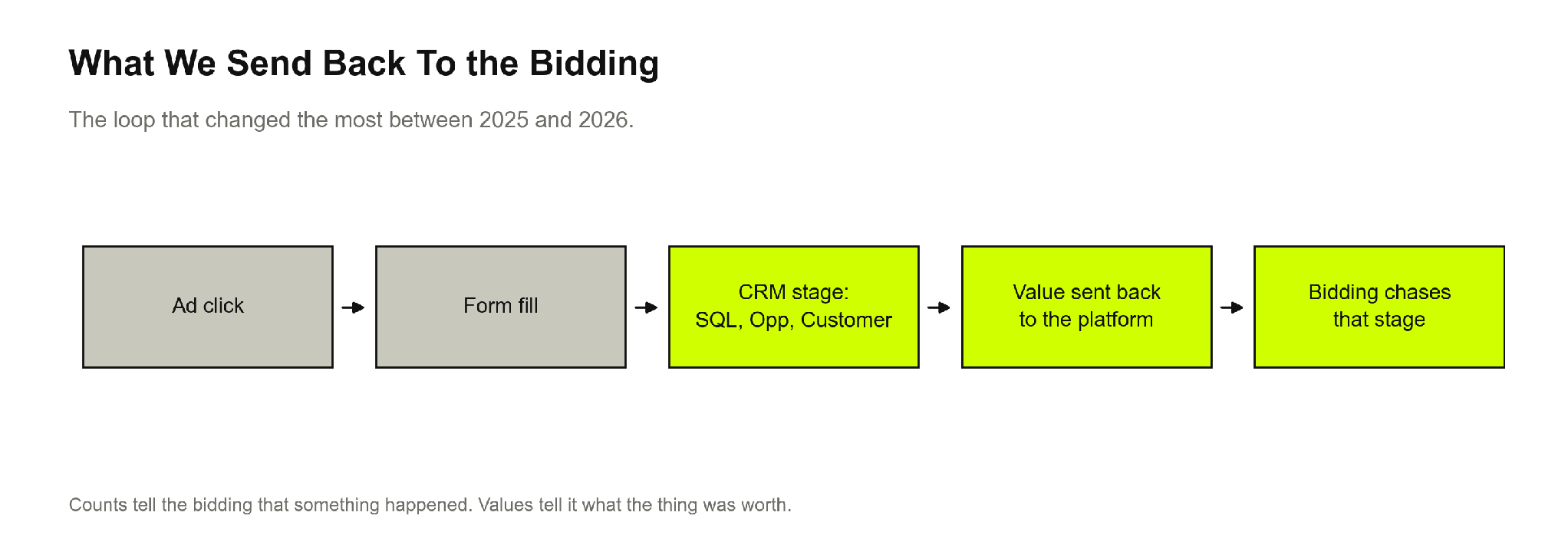
Until then we sent Google conversion counts. Every form looked identical to the bidding, so it went and found the cheapest ones.
In the first week of August we started sending values from HubSpot instead.
Leads Reaching Opportunity Rose By About a Third
Over the next two quarters about a third more of that account's leads turned into opportunities, and each one cost about a third less. We hadn't touched the ads.
Every agency in this category describes the funnel to the client in a deck. Almost nobody describes it to Google.
— Mahesh Sundararaman, Director of Growth, TripleDart
What We Send Back Now
Doing one of these without the others does very little.
1. One conversion goal instead of five. Most accounts arrive with every form on the site marked primary. We cut it back to a confirmed demo.
2. Values on the events, from the CRM. HubSpot writes back what each stage is worth.
3. Only the stages below MQL. On our ABM accounts we pass Opportunity, SQL and Customer.
4. Offline conversions, uploaded. Deals that close on a call never touch a pixel.
We Test What It Does
On one account we ran A/B tests against AI Max and won 11 of 19. Every winner carried a target ROAS 20% to 30% below the account baseline, and setting it at baseline lost every time.
Through 2025: Google and Meta Took the Controls
We Stopped Choosing Where the Money Went
With broad match and smart bidding we stopped picking the exact searches we showed up for. Performance Max spread budget across inventory we couldn't see, Advantage+ took audience targeting off Meta, and by Q1 2026 AI Max was a default.
You can switch individual settings off, and we do, but the direction of travel belonged to Google and Meta.
Buyers now discover software through ChatGPT, Perplexity, Gemini, Reddit, and communities long before they ever click an ad. Ad platforms went AI-first auctions, targeting, creative, all of it. The playbook that worked in 2023 quietly stopped working.
— Sabarinathan Rajeswaran, Co-Founder, TripleDart, writing on LinkedIn
On Meta the Ad Picks the Audience
Advantage+ chooses who sees an ad, which leaves the creative doing the job the audience settings used to do.
We ran a hospitality-angle ad for a connected-appliance client and it pulled leads from two international hotel groups.
We Can't See Where Performance Max Spends
Asset group data isn't available unless you run a product feed, and most B2B accounts don't.
So we work it out by subtraction. Marketing images only run on display and discovery, so adding those up gives us the display number. Take display, video and shopping off the total and what's left is search.
December 2025: The Cheapest Leads We Ever Bought
Same Month, Two Campaign Types
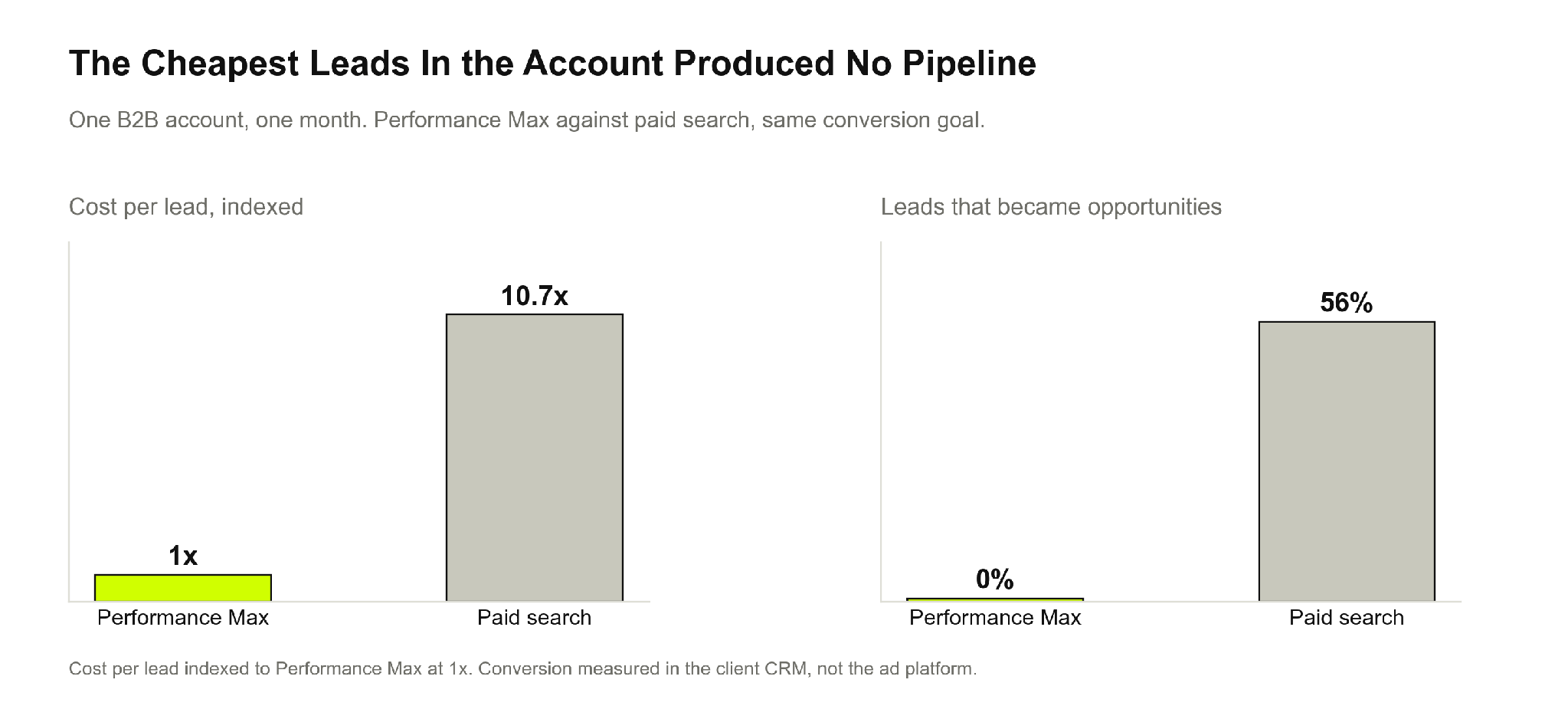
Performance Max cost a tenth as much per lead and produced no pipeline. We'd told it to find leads and it went and found leads.
It Was Charging Us For the Client's Own Name
The client's brand name cost about a tenth as much per click inside Performance Max as it did in the brand search campaign. Performance Max was collecting demand the brand had already created, then booking the credit.
A competitor-targeted Performance Max campaign on the same account produced nothing but junk, and when we broke delivery down it was serving entirely on the display network.
Six Months of the Same Thing On a Self-Serve Product
One client sells creator software on a monthly subscription, with no sales team. We split its search budget by keyword theme and followed each theme through to a paying customer.
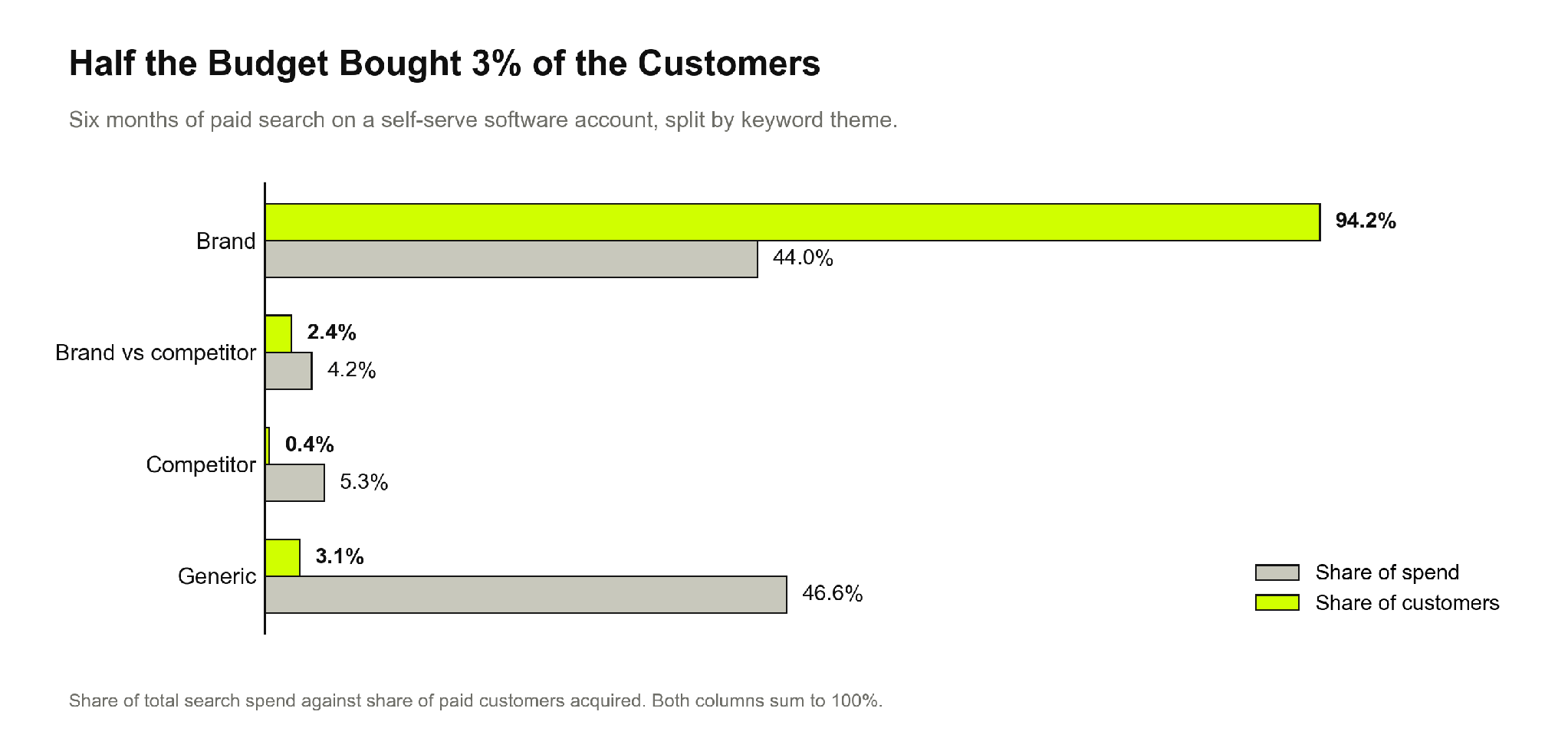
Generic keywords took 46.6% of the money and produced 3.1% of the customers. Brand took 44% and produced 94.2%, at about a thirtieth of the cost per customer.
Competitor keywords looked like the best traffic in the account, turning clicks into signups at about twice brand's rate, and almost none of those signups ever paid.
Early 2026: We Changed What the Machines Chase
We Told the Bidding To Chase Opportunities
An education software client in India had a problem in its demo calendar. Cancellations doubled over two months, and most of the extra ones came from Performance Max after a learning reset.
We changed the conversion goal from Lead to Opportunity and split the campaign by device.
Cost per lead went up, and every stage under it improved.
We Changed the Scoreboard
A corporate travel client had signups growing faster than the funnel could convert them. Paid social was bringing signups that never activated, while paid search carried the conversion load.
So we made activations the headline number. That's when the useful split showed up: people signing up from a business email domain activated at nearly three times the rate of everyone else.
We Rebuilt the Structure On a Bigger Account
A billing infrastructure client got the same work across a longer window.
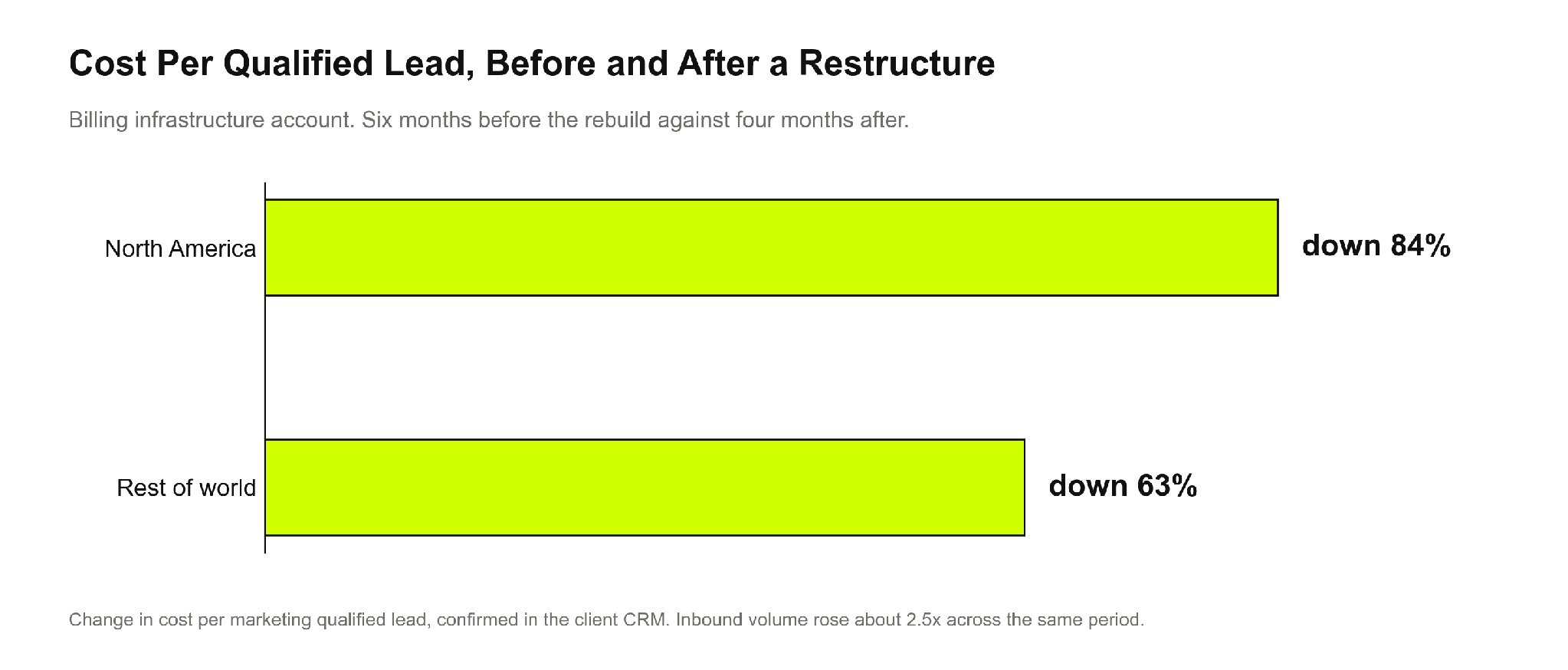
Cost per qualified lead came down about 84% in North America and 63% across the rest of the world, while inbound volume rose about 2.5 times.
The Channels Stopped Being Separate Conversations
Most of our spend went into search. The rest of it moved differently, and by 2026 we'd stopped planning any of it channel by channel.
Three Platforms Put Their Name Next To Ours
In May we kept Google Premier Partner status for a second year. In June we became a globally certified LinkedIn Ads agency. In July Google made us an International Growth Agency Partner, and as far as we can tell we're the first B2B agency in India to hold it.
When you bootstrap a global B2B agency, nobody hands you these. You can't buy your way in. The platforms look at how you actually run accounts, the discipline, the outcomes, whether you treat someone else's budget like your own and then they decide whether they're willing to stand behind you.
— Sabarinathan Rajeswaran, Co-Founder, TripleDart, writing on LinkedIn
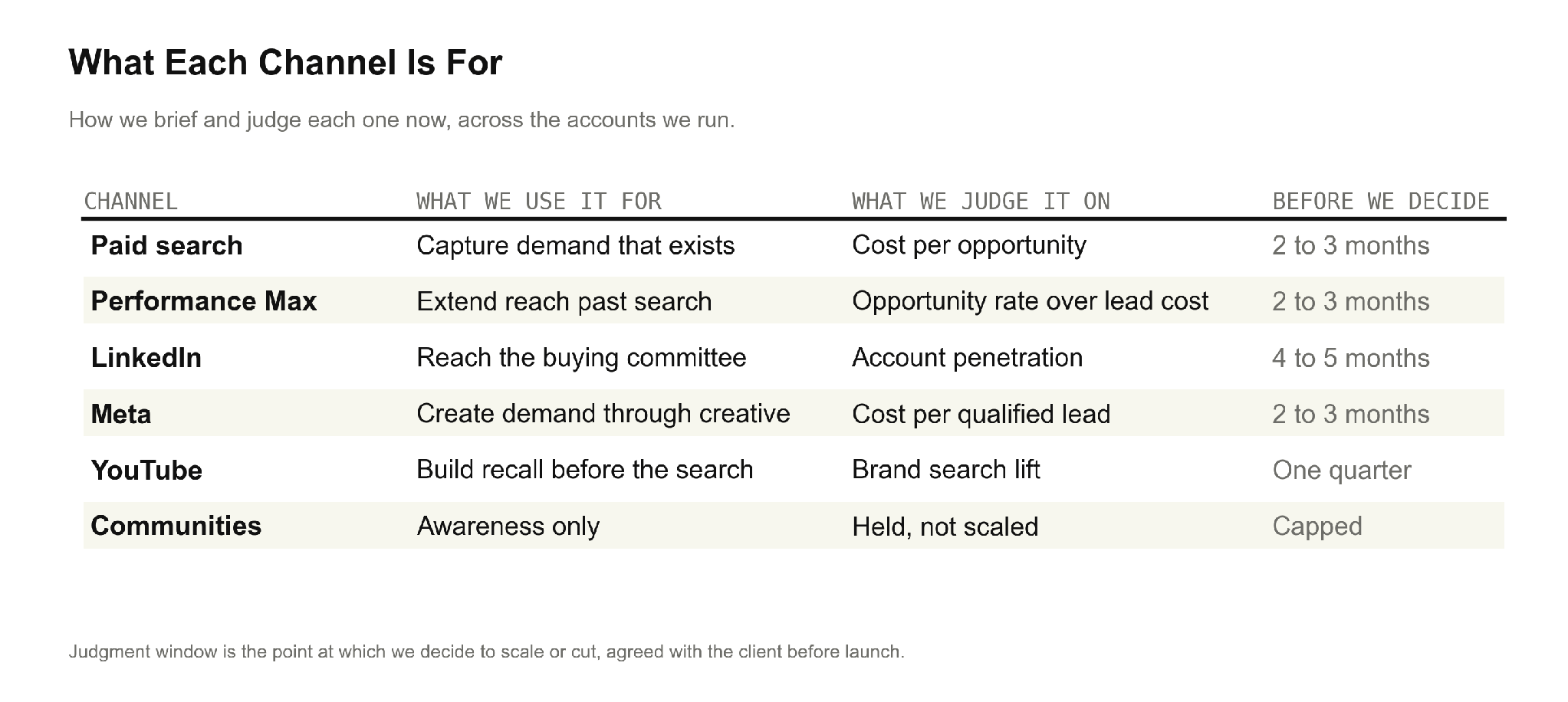
On LinkedIn the Problem Was Never the Ads
LinkedIn is where the reporting gap hurts most, because the buying cycle outruns the reporting cycle. One account generated a qualified lead in August that became an opportunity in December, five months later, worth $42,000 in pipeline. Read monthly, that channel looked dead for four months.
So we changed what we report on it. Where LinkedIn won't produce forms, we measure how much of the target account list we've reached and how often.
One client's ABM program moved from 7.7% of a 68,000-person audience to 11% over a quarter, at a frequency of roughly three, and put enterprise accounts into pipeline without a single form fill.
Formats matter more here than on search. Thought leader ads, run under a person's name instead of the company's, have consistently produced our cheapest clicks on LinkedIn by a wide margin, and one executive's post drove around 32 companies to a client's site with no clickable call to action on it at all.
On Meta the Creative Does the Targeting
Advantage+ decides who sees an ad, so the creative is the audience choice. We treat a Meta brief as a targeting decision now, and we refresh creative monthly with several variants per audience, since the settings we used to tune no longer exist.
That's also why Meta reads so differently across accounts. On one it produced leads at two to three times better cost than search every month for a quarter. On another its signups activated at a fraction of search's rate, so we moved it out of the acquisition line and into demand creation.
One Budget, Not Five
The change that pulled it together was planning across channels instead of inside them. Once conversion values were flowing back from the CRM, we could compare a LinkedIn opportunity to a search opportunity honestly, which meant the budget conversation stopped being a negotiation between channel owners.
On a global HR tech account in a market where search demand fell 16% year on year, that looked like this:
Ninety days later that program had turned $1 of ad spend into $6 of pipeline, and more than $200,000 of it, in a category most teams were pulling back from.
What We're Building For Next
Buyers are finding software in places we can't buy yet. Our own client data shows it: one account's AI referral contacts grew 50% quarter on quarter, arriving from ChatGPT, Perplexity and Gemini, and converting through to customers.
Ad surfaces are arriving inside those products, and we're instrumenting for them now. We tag AI referral traffic separately so it shows up, and we track which of a client's pages get cited in AI answers.
When those surfaces open to buying, the accounts that already know which pages the models trust will start from somewhere.
2026: We Closed the Agency For Two Days
We Shut the Doors
We stopped normal operations, pulled more than 50 people off client work, and put them on 14 problem areas across paid media, SEO, creative and revenue operations. Teams built on live accounts instead of sandboxes.
What We Were Renting
Factors.ai for attribution. Demandbase for account staging. Fibbler for LinkedIn scheduling and impression caps. Vector and RB2B for visitor identification. Clay for enrichment. Smartlead and HeyReach for outbound. A $199 Google Ads script to see inside Performance Max.
All of them moved data around and none of them made a judgment, so the judgment was still 6 to 10 hours of an analyst's week.
We charge a flat monthly retainer and never a percentage of spend. An hour we save is an hour we keep. It also means we can tell a client to spend less without arguing with our own invoice.
— Shiyam Sunder, Founder, TripleDart
What We Automated First
We started building the negation workflow in July 2025, nine months before it had a product name, because an analyst was tired of doing it by hand.
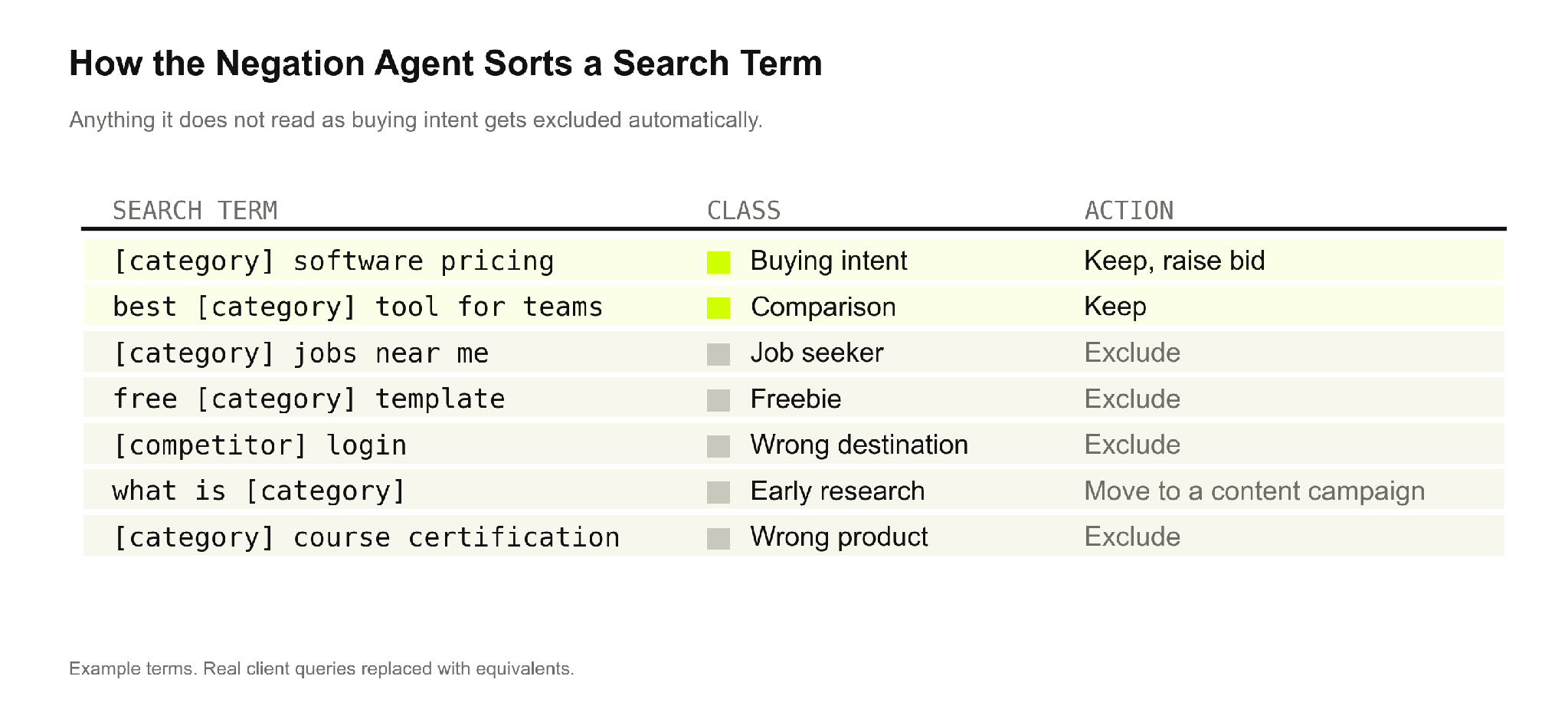
The audit agent's rules are that same list of things we kept finding, written down and extended.
None of them decides anything that costs money, so a budget move or a campaign pause still goes to a person. The audit agent hands that person a table with the money attached:
Jarvis Sits In Slack Where the Team Already Talks
The agents each did one job. Jarvis is where they meet the account team, and it lives in Slack because that's where the work already happens.
It reads the platforms directly. Google Ads across every account in the MCC, LinkedIn Ads across 24 accounts, and Search Console across 104 properties. When someone asks how last week looked, the answer comes from the API instead of a spreadsheet somebody exported on Friday.
Channel summaries post to internal channels only. Task creation waits for Gowtham or JK to sign off.
Leverage Is the LinkedIn Half
Google had a decade of tooling built around it. LinkedIn didn't, so we built our own.
Leverage sits on top of the ad account and the CRM. Before a campaign launches it turns an ICP description into LinkedIn's actual targeting facets, sizes the audience, and drafts a creative brief with competitor references.
After launch it ranks creatives by which are fatiguing and which are producing the cheapest qualified action, then joins LinkedIn conversions to what happened in HubSpot.
Three parts of it exist because the platform doesn't offer them:
Dayparting: Campaign Manager runs a campaign around the clock or you pause it by hand. Leverage sets days and hours per campaign and pauses and resumes on its own. A lead form submitted at 2am converts at a fraction of one submitted in business hours, and nobody has to remember to switch the ads back on Monday.
Competitor work the Ad Library can't do: Ad Library shows a company's active ads one at a time. Leverage shows the inactive ones and how long each ran, filters to thought leader ads, groups a competitor's themes so you see the pattern, compares up to five competitors side by side, and tracks whether their cadence is ramping or pulling back month over month. It works without a LinkedIn login, so anyone on the team can look.
Warm accounts, joined to deal state: Companies engaging with the ads that don't have an open deal yet, split between the ones that are new and the ones whose engagement more than doubled. Sales works that queue first. Alongside it sits a per-account timeline laying LinkedIn exposure over the HubSpot deal history, and exclusion lists we push back to LinkedIn so budget stops chasing accounts that already closed.
Leverage is what Campaign Manager and Ad Library would look like if a paid team built them, with the CRM already plugged in.
— Sabarinathan Rajeswaran, Co-Founder, TripleDart
What We Still Do By Hand
Some of the work went into software. This didn't, because each one turns on a judgment a rule can't make.
Sometimes We Switch the Automation Off
One client sells player support software to gaming studios, and its whole target list was under 1,500 accounts.
Automated bidding had nothing to learn from at that size, so we moved those campaigns to manual CPC. Cost per click fell by about 90%, CPMs by about 70%, and engagement rate rose by about 60%.
Sometimes the Ads Are Fine and the Market Has Gone
We had to tell an employer of record client that nothing was wrong with their campaigns.
They were winning almost every impression available on brand, and all of them on competitor terms. Over 10 weeks we tracked search volume across their supply markets, and it was leaving.
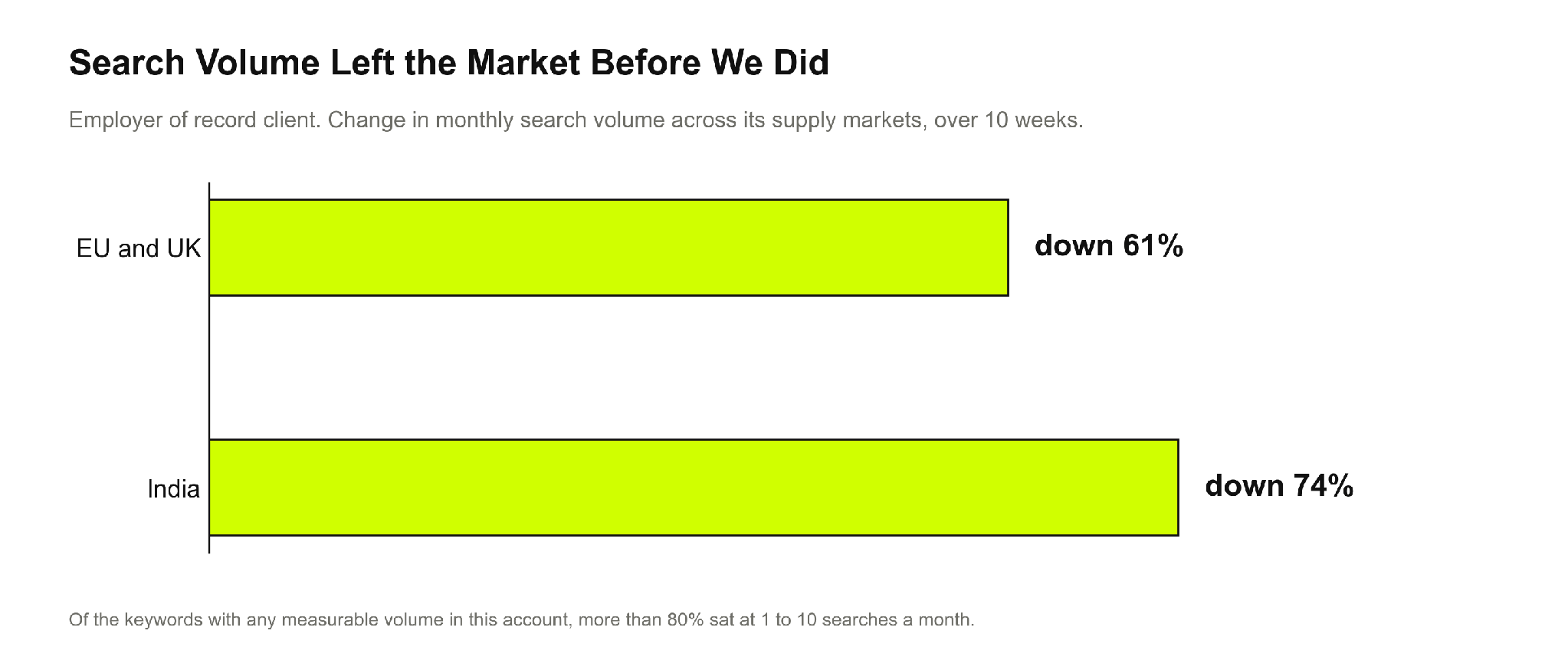
More than 80% of the keywords with any measurable volume in that account sat at 1 to 10 searches a month, and no bidding change buys searches that don't exist.
Sometimes the Auction Is the Problem
Google tells you how much impression share you lost and splits it into rank and budget, and the two need opposite answers. Losing to budget means you ran out of money. Losing to rank means the ad wasn't strong enough to win the slot, so more money won't help.
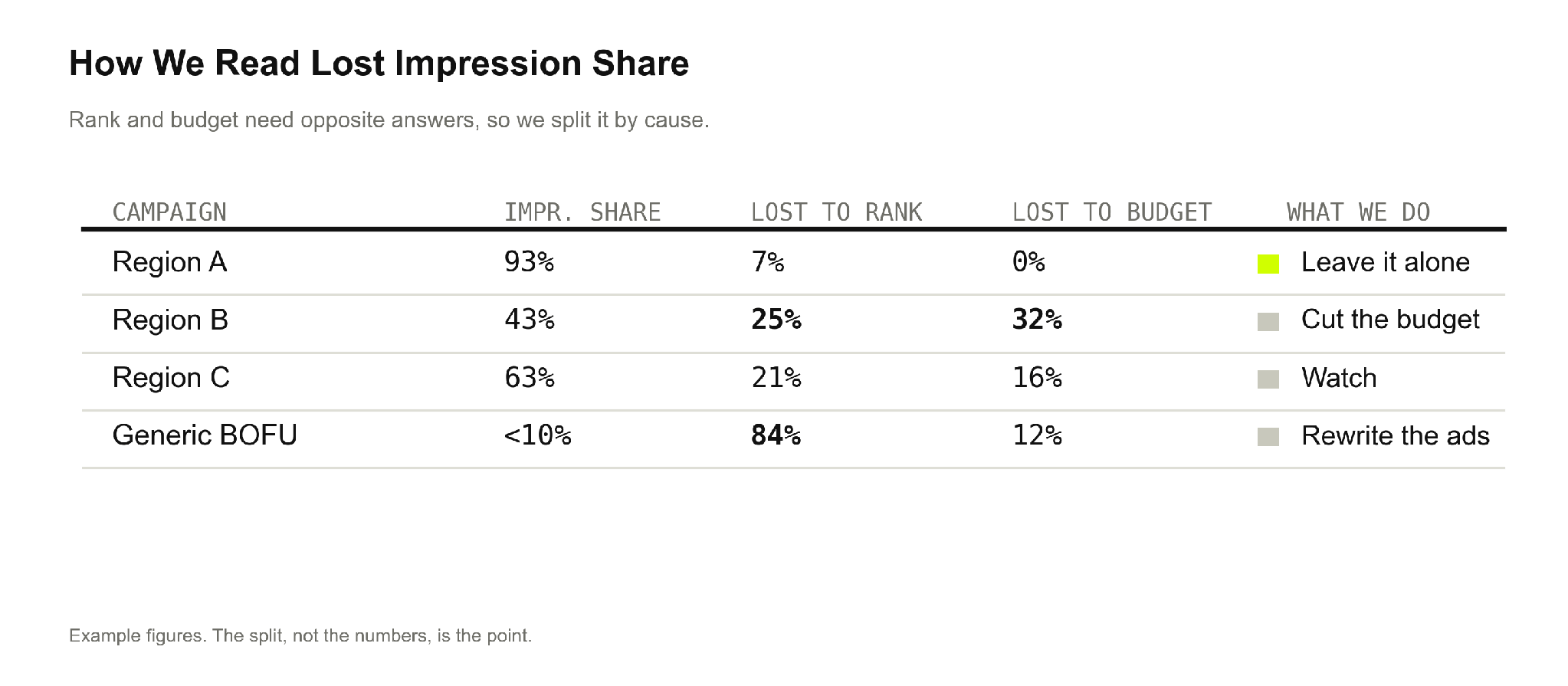
On one account the same competitor keywords behaved completely differently from one region to the next. North America was losing a third of its share to budget and still producing nothing, so we cut it, and India was winning nearly every impression going, so we left it alone.
Another campaign sat under 10% impression share with most of the loss going to rank, so we rewrote the ads instead of raising the budget.
Sometimes People Are Clicking the Logo
We refreshed a set of G2 review creatives on LinkedIn and the numbers went backwards, with clicks down 62% and click-through rate down about half.
The old version had a much bigger G2 badge on it, and people had been clicking the badge.
Sometimes We Tell a Client To Spend Less
A client gave us a monthly budget for a new market and we told them we wouldn't use all of it. If we could hit the qualified lead target on about two thirds of the money, we'd rather hold that number.
On the same account another month, roughly a third of the budget went unspent. We wanted to know whether the money was there but never reaching a query worth bidding on.
What a Week Looks Like Now
Monday, Before Anyone Opens a Laptop
The Slack CoPilot has posted cost per lead movement and flagged anomalies for every account. The negation agent has sorted last week's search terms, and the audit agent has re-run on anything that changed.
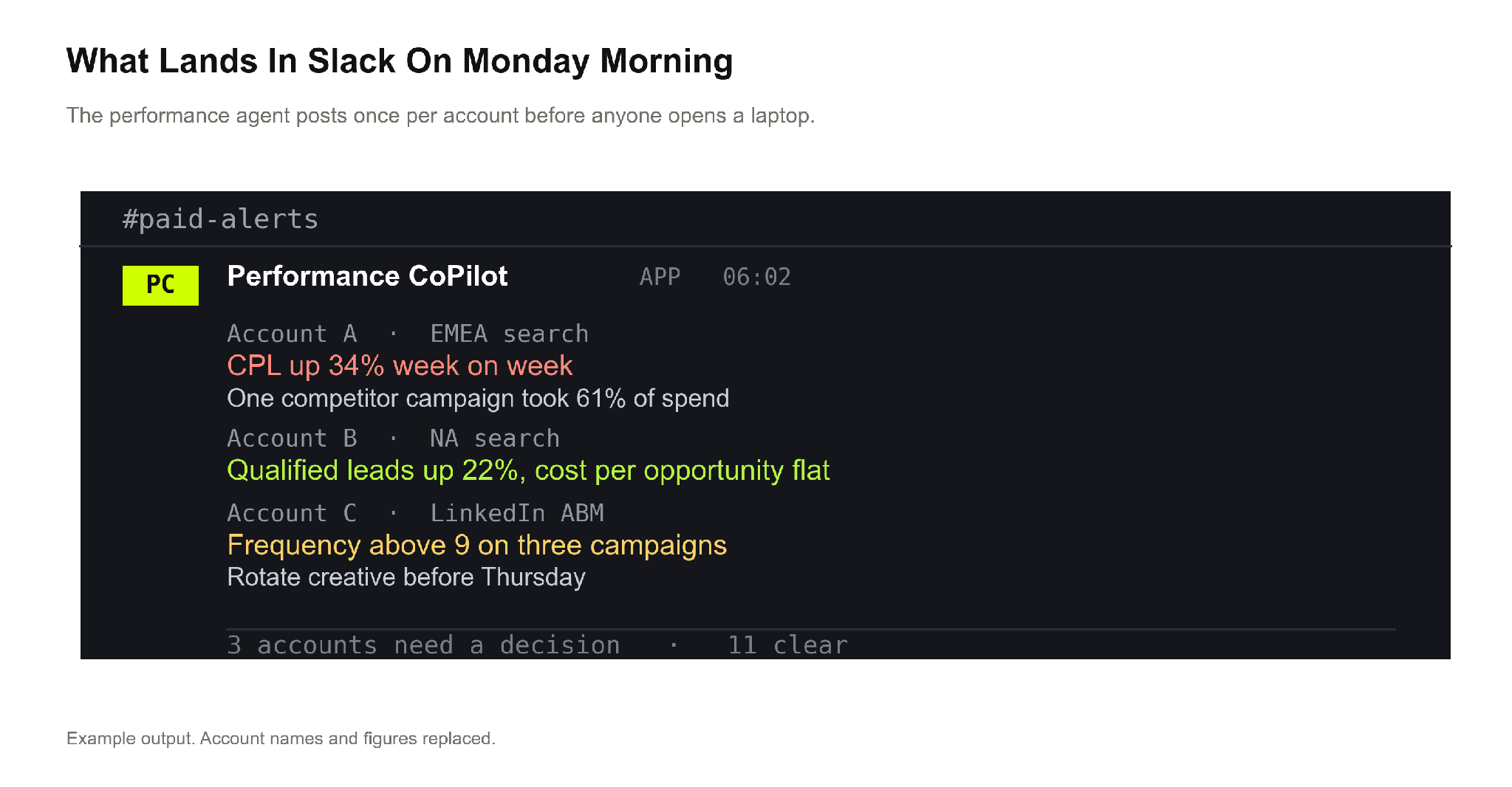
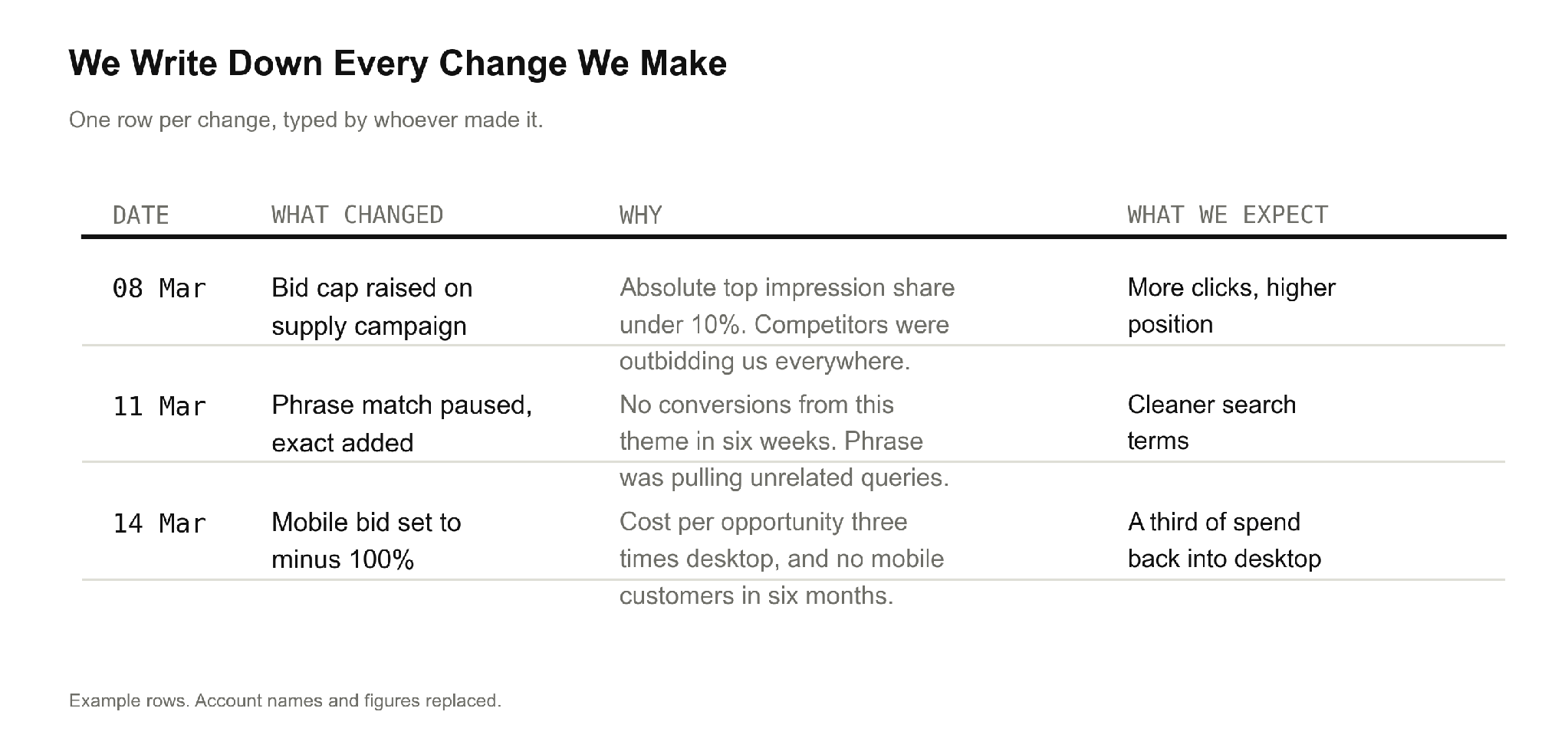
An analyst reads it, decides what to act on, and writes down what changed, why, and what they expect it to do. That last part is still typed by a person.
What We Started and Stopped
What Clients Got
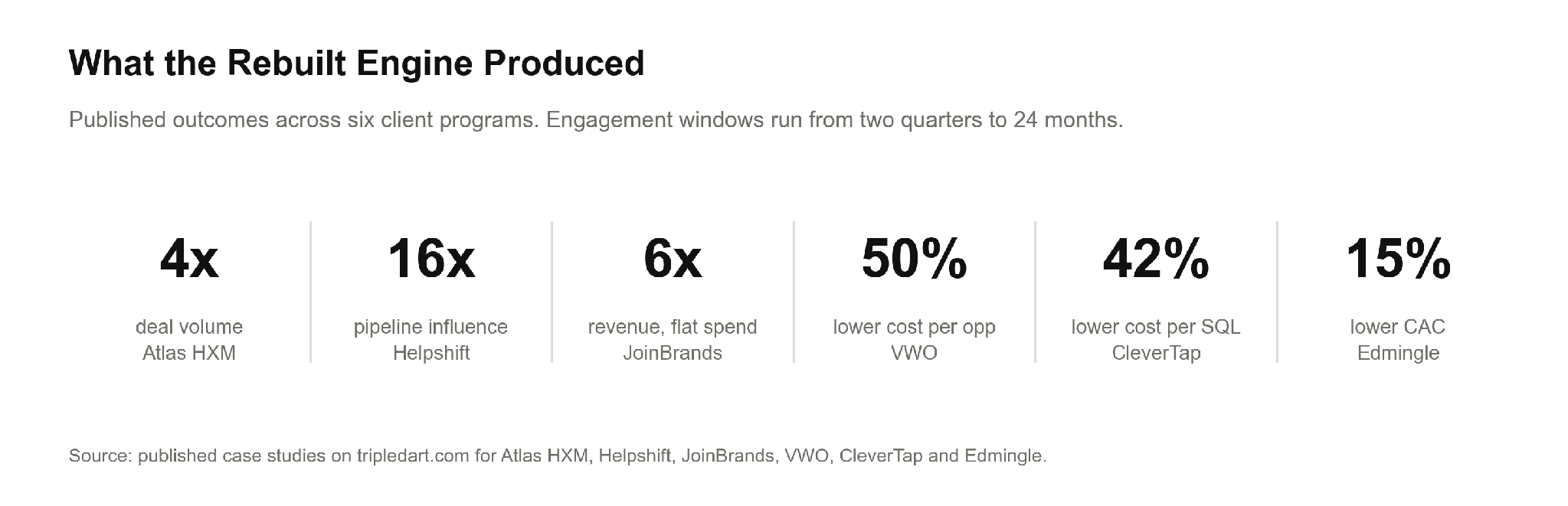
Atlas HXM, Global Employment
Seven months, April to November 2025.
An agency that can tell you things you don't know and elevate your strategic thinking stands apart.
— Tina Robertson, VP of Global Growth Marketing, Atlas HXM
Helpshift, Player Support For Gaming
24 months, run almost entirely on LinkedIn and Demandbase.
They helped us define our ICP more tightly, segment audiences more effectively, and build messaging tailored to each account segment and persona.
— Viral Patel, Head of Marketing, Helpshift
VWO, Experimentation Platform
Two quarters. Nearly half the brand budget had been going to branded keywords, and portfolio bidding was favoring the lower-quality leads.
CleverTap, Customer Engagement
24 months across Google, Bing, LinkedIn and Meta. We consolidated more than 50 campaigns down to 30.
The team is dependable, takes ownership, and maintains agility to deliver.
— Rahul Mantena, Lead of Performance Marketing, CleverTap
What We're Still Working On
Cheap Clicks, Three Platforms
One video creative, three platforms, same week, same landing page.
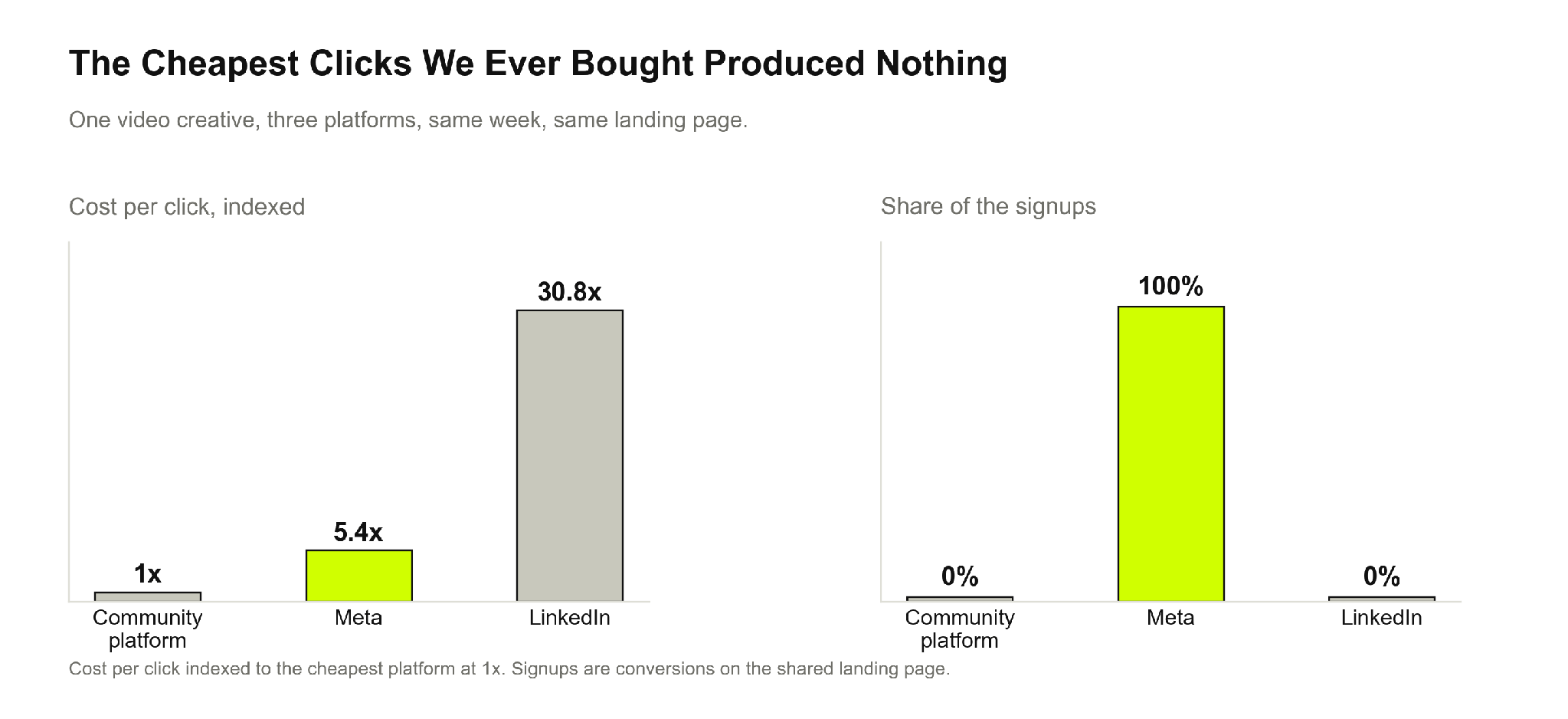
Clicks on the community platform cost about a fifth of Meta's and a thirtieth of LinkedIn's, and Meta produced every single signup.
A 97% bounce rate and 3-second sessions tell us the audience was wrong, whatever the clicks cost.
What You Could Try
Rank your campaigns by cost per opportunity, then compare that order to your cost per lead order. On our accounts the top and bottom often swap places. If you can't build the second list at all, start there.
Send conversion values back from your CRM, and only send the stages below MQL. Counts tell the bidding something happened. Values tell it what the thing was worth.
Split your lost impression share into rank and budget before you touch either. Rank loss is an ad relevance problem, and more money won't move it.
Frequently Asked Questions
Should We Still Run Performance Max For B2B Lead Gen?
Yes, if you change what it's chasing. Fed a lead goal, one of our campaigns brought leads in at a tenth of what paid search was paying and none of them became an opportunity. On another account we switched the conversion goal to Opportunity and cost per opportunity came down about threefold at similar spend. Load brand negatives before you launch, or it'll collect demand your brand already created and book the credit.
Why Is Our Cost Per Lead Falling While Pipeline Stays Flat?
Usually because the bidding has been told to find leads and nothing else. Every form looks identical to it, so it goes and finds the cheapest ones. On one self-serve account, generic keywords took 46.6% of the search budget and produced 3.1% of the customers.
What Should We Send Back To Google?
Values from the CRM instead of counts. Pass only the stages below MQL, so Opportunity, SQL and Customer. Cut the account back to one primary conversion action, usually a confirmed demo. Upload the deals that close on a call, since those never touch a pixel.
What Changes When We Do That?
On one account about a third more leads turned into opportunities over two quarters, and each one cost about a third less. We hadn't touched the ads.
Is Manual CPC Still Useful?
On small audiences, yes. One client's whole target list was under 1,500 accounts, which gave automated bidding nothing to learn from. We moved those campaigns to manual CPC and cost per click fell about 90%, CPMs about 70%, and engagement rose about 60%.
How Should We Set Targets For AI Max?
Below your account baseline. We won 11 of 19 tests on one account, and every winner sat 20% to 30% under baseline target ROAS. Setting it at the number we wanted to land on lost every time.
How Do We Read Lost Impression Share?
Split it into rank and budget first, because they need opposite answers. Losing to budget means you ran out of money. Losing to rank means the ad wasn't strong enough to win the slot, so more money won't help. One of our campaigns sat under 10% impression share with most of the loss going to rank, and we rewrote the ads.
How Do We Tell Whether It's Our Ads Or The Market?
Track search volume alongside your own metrics. One client was winning almost every impression available on brand and all of them on competitor terms, while volume across their supply markets fell 61% in the EU and UK and 74% in India. No bidding change buys searches that don't exist.
Does Reddit Work For B2B?
It hasn't for us. We ran one video creative across three platforms in the same week, to the same landing page. Clicks on Reddit cost about a fifth of Meta's and a thirtieth of LinkedIn's, and Meta produced every signup. A 97% bounce rate and 3-second sessions point at the audience rather than the price.
Can AI Agents Run A Paid Account?
They run everything except the parts that cost money. Ours audit accounts, sort search terms, draft landing pages and post what moved to Slack every Monday. A budget change or a campaign pause still goes to a person.
How Long Before We Judge A New Channel?
Put a date and a kill number on it before you launch. We also report cost per opportunity ahead of cost per lead, so the decision doesn't get made on the cheapest number available.

summarize with ai


